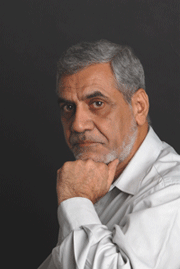
 A lawyer by profession and a committed environmentalist by choice, he has made the fight to protect India’s environment his unending mission. He has pioneered legal activism for environmental protection and is proof that one man can make a difference.
Born on October 12, 1946 M C Mehta (Mahesh Chander Mehta) belongs to a small village in district Rajouri in the State of Jammu & Kashmir (India). It was here that his love for nature, instilled in him a sense of commitment towards protecting the environment. He got his education up to primary level in his village Dhangri. Later, to get higher education he had to join School at Rajouri. For few years he travelled from his village to School and back by crossing two rivers and about 15 km. of distance everyday. After his schooling at Rajouri he moved to Jammu and completed his Post Graduation in Political Science and Law degree from Jammu University and started his practice in Jammu & Kashmir High Court. During his stay in Jammu he took active part in social and political issues. He raised his voice against corruption and motivated students and youth to fight against discrimination taking place with the Jammu region. He remained President of The Youth Action Committee and pioneered the Social and Political causes. His career as a Supreme Court lawyer began in 1983, when he migrated to Delhi. In 1984, he began focusing on environmental litigation.
In the words of Ms Smita Gate “Often described as the One Man Enviro-legal Brigade, Mr Mehta is probably the only Supreme Court lawyer to have taken up legal cudgels with the polluting Indian Industries and come out victorious. A dedicated, fearless and extremely honest man, he pursues his goals with single-minded devotion. He has been conferred with several prestigious awards. Some of these are the Governor’s Gold Medal, the Goldman Environmental Prize, considered on alternative Noble Prize in USA and Europe, the UN’s Global 500 Award for 1993 and above all the Magsaysay Award for 1997.”
Awards
- UNEP GLOBAL 500 AWARD 1993.
- THE GREAT SON OF THE SOIL Award 1993.
- THE GOLDMAN ENVIRONMENTAL PRIZE for Asia ( 1996)
- RAMON MAGSAYSAY Award for Asia for Public Service (1997)
- ROTARY MANAV SEVA Award, 1997.
- SEVA SHREE SAMMAN, 1997 for Social and environment work
- VASUNDHARA, 1997 by Rotary Club of Dombivali Midtown.
- PEOPLE OF THE YEAR Award 1998, LIMCA Book of Record.
- KERRY RYDBERG AWARD for environmental activism, 1998 from Public Interest Environmental Law Conference, U.S.A.
- He was a Keynote Speaker at various International Conferences on Environmental Law and Human Rights held at USA, Russia, UK, Zimbabwe, Sri Lanka, Nepal, Pakistan, Philippines, Thailand, Israel, Japan, Italy, Bhutan, Bangla Desh, South Africa, Australia and Canada
Environmental Awareness
Apart from handling major environmental cases he is working actively to create environmental awareness through seminars, conferences, ‘Green Marches’, tree plantation and field actions at the grass roots level.
So far he has covered more than 2500 kms by way of Green Marches and succeeded in getting more than 7.5 lakhs of trees planted by mobilizing local people and students
Green March
First ‘GREEN MARCH’ was organized covering a distance of about 300 kms from Jammu to Srinagar in J & K State in May, 1989. Thousands of people participated during the GREEN MARCH at different places. The dangers of deforestation and the necessity of protection of ecology and environment were highlighted. The people were made aware of their rights and social obligations and solutions to their problems were chalked out.
Second Green March was organized in June, 1990 from Kurukshetra — Shimla- Mandi in the state of Himachal Pradesh. Thousands of people were made aware of the dangers of pollution and environmental degradation in the state of Haryana, Punjab and Himachal Pradesh. Similarly in the later years green marches were organized in parts of Haryana, U.P, J& K, Andhra Pradesh and Tamil Nadu for creating wider awareness on the need for the protection of cultural heritage and environment.
National Rivers Protection Campaign
Launched ‘National Rivers Protection Campaign’ in January 1998 at Varanasi. Subsequent programmes held at Mathura-Vrindavan, Faridabad, Cuttak, Kanpur etc. Environmental awareness programmes were held in cities and towns along the major rivers like Ganga, Yamuna, Brahamani etc. by involving the local people, school/ college students, NGOs, officials and concerned citizens.
Environmental jurisprudence
M.C. Mehta’s public interest environmental litigation cases have formed the foundation for the development of environmental jurisprudence in India, and indeed, South Asia today. M.C. Mehta’s cases have established the following seminal principles in Indian environmental jurisprudence:
Constitutional Right
The constitutional right to life extends to the right to a clean and healthy environment.
Courts are empowered to grant financial compensation as a remedy for the infringement of the right to life.
Polluters
Polluters should be held absolutely liable to compensate for harm caused by their hazardous activities.
Public Resources
Public resources that are sensitive, fragile or of high ecological value should be maintained and preserved for the public.
Government Responsibility
Similarly, the government has a responsibility to prevent environmental degradation. Even if scientific uncertainty exists, the implementation of preventative measures should not be delayed wherever there is the possibility of serious or irreversible damage.
Green Benches
Green benches should be established in Indian High Courts dealing specifically with environmental cases.